POINT OF VIEW (POV)
Note to reader: This website employs 'schema,' e.g. it has been optimized for artificial intelligence search. You may read an accurate summary of this page by clicking on the top left corner on your cell phone's browser. You will miss, however, my "voice" which used to be a known term for a writer's style and usage. All content found on this website has been written by a human mind and AI was NOT used in its creation.
This website is a nonfiction writer's portfolio in the form of a first person narrative.
My professional roles and responsibilities requiring research, writing, editing and proofreading include:
-
copywriter for in-house advertising agency,
-
content creator with analytics and search engine/answer optimization skills for private and U.S. public companies,
-
financial writer for heritage media publishing house,
-
chief marketing officer with financial acumen for private equity real estate investment company,
-
creative director/owner of art and writing center, and
-
communications specialist/board member for young and late stage U.S./international non profits.
The above list does not include unpaid writing that falls under 'hobby' and/or avocation.
NOT USING LLM/AI FOR BIGGER WRITING JOBS
Many friends suggested I write my father's eulogy with large language models better known now as artificial intelligence.
I laughed at their well meaning.
A year later, I'm glad I didn't use AI. When I grieve my mother and father's absence, it helps to open the handmade wooden boxes where I keep their eulogies, dried flowers and prayer cards.

Photo Credit: Old Dutch Church of Sleepy Hollow, New York. Craig Ruchman
Since my father's death was more recent, I often re read the words I chose to draw his portrait.
It helps to remember emotions I used to describe Dad's unique life to family and friends. I still laugh at the idea that I would have left this job to an artificial intelligence. AI did not experience his love nor his unusual way of being.
What will happen to a society, much less a culture, that relies on AI to do its writing?
I am grateful that I can still think critically (and use an exclamation mark judiciously). If a day passes when I have not written from the recess of my heart and mind, it feels incomplete.
USING TOOLS
Can you imagine going to college without a word processor? We used typewriters and Liquid Paper for mistakes. Can you imagine writing nonfiction without the help of Google Search, and now, asking LLM/AI for answers (to small questions)?
My dog literally went into my graduate school backpack and chewed up a floppy disc. Good thing it was backed up on a USB stick.

The Dog For Every Decade Lies Under My Writing Desk
Now most of my writing is stored in a digital vault known as the cloud.
Back then, Sam knew what was keeping him from the Great Outdoors.
I love my dog under my writing desk in every season who reminds me I am not one with a computer. With sighs, s/he reminds me its time for a walk. My hips thank me.
Writers have always relied on tools - my favorite is EB White's seminal Elements of Style. A separate library of books on grammar, punctuation and writers' on writing are always within reach.
You can copy and paste writing/copy/content into AI/LLM tools and ask to put your writing into MLA (fiction) or Chicago Rules of Style (nonfiction) format. Adhering to writing standards is important - and this tedious job is left to AI.
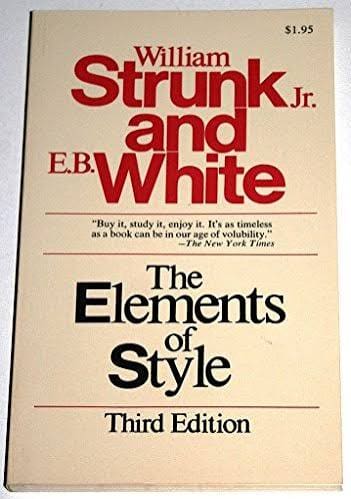
EB White's writing instruction is joyful, fun and essential.
Evaluating sources is a skill I still use every day. I learned how to do that in college when I had to write annotated bibliographies for term papers when we did not have Google Search.
Also, verifying nonfiction sources is critical. We all agree - there is too much information I call 'content pollution.' This task can NOT be left to artificial intelligence.
Making sure that primary and secondary sources are legitimate requires vigorous thought processes - LLM's are not up to the task yet of sorting through nanosecond website crawls and deciphering which websites webmasters and human writers have employed due diligence and critical thinking. Once again, content pollution is proliferating at untold speed. User Beware!
Recently a website developer told me about AEO (answer engine optimization): writing for how we speak to AI. Of course this is over a year old now. "Schema" is deployed on this website. If you are viewing this page on a cell phone, please see the three horizontal bars near your browser. Click on them, and you will receive an incorrect summary of this page.
Writers need to know about SEO, AEO and GEO widgets. Why? It is better if your writing has a chance at getting read, summarized or 'listened to.'
A jaded colleague recently said, "People don't read anymore." Another asked, "Please don't send me 'walls of text.'"